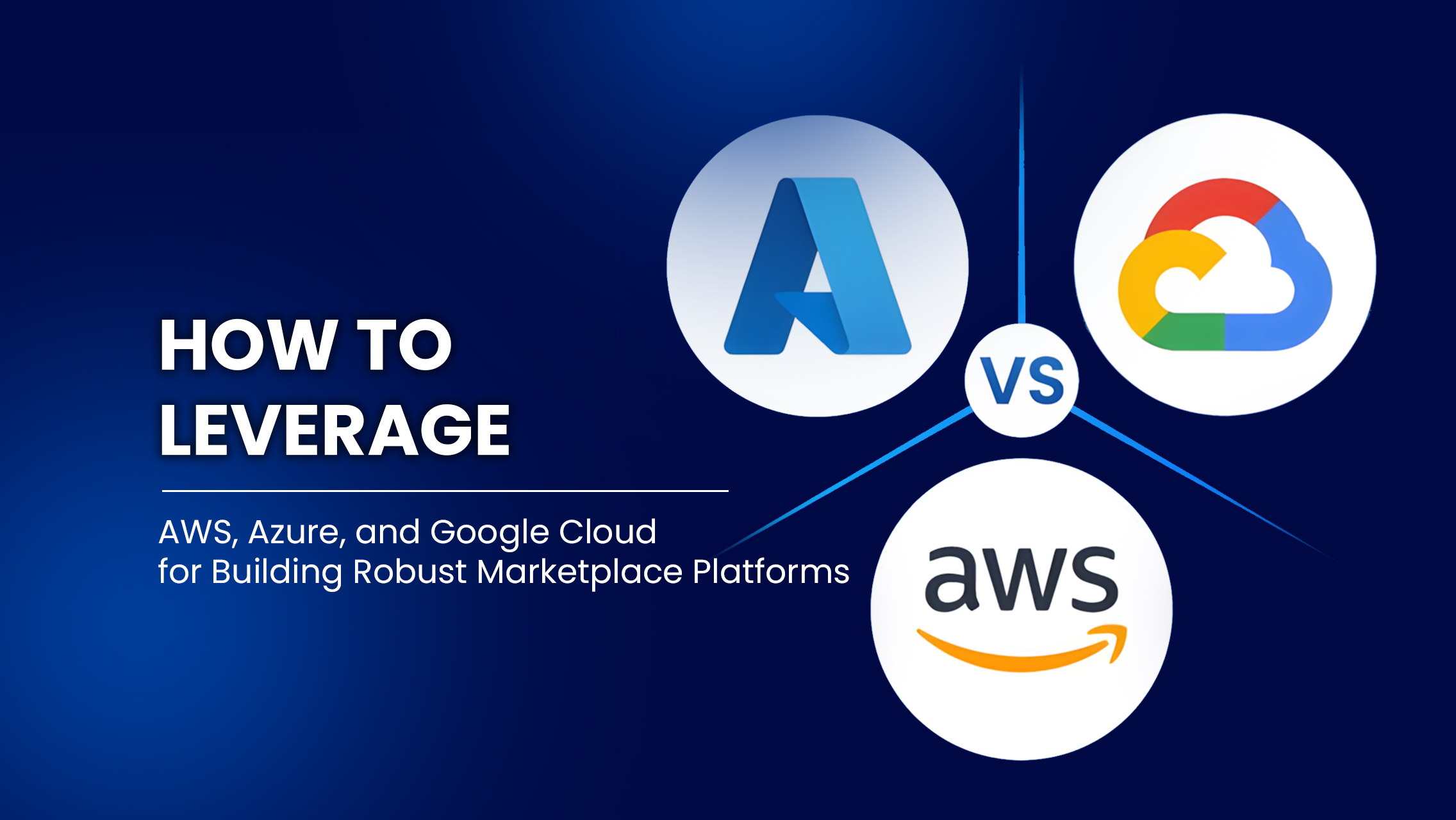
The marketplace model—whether B2B, B2C, or P2P—has become the backbone of digital commerce. But building and scaling such platforms requires more than just a sleek UI and a good marketing strategy. Cloud computing is at the heart of modern, robust marketplaces, and the three major players—Amazon Web Services (AWS), Microsoft Azure, and Google Cloud Platform (GCP)—offer powerful tools to bring your vision to life.
In this article, we explore how each cloud provider can help build scalable, secure, and high-performing marketplace platforms.
Why Cloud Infrastructure Matters for Marketplaces
A modern marketplace demands:
- High availability & fault tolerance
- Auto-scaling capabilities
- Real-time analytics
- Secure payment and identity systems
- Seamless integrations with third-party tools
Cloud providers offer all this and more—on a pay-as-you-go model—enabling rapid MVP development and global expansion.
Using AWS to Build Marketplace Platforms
Strengths
- Industry-leading scalability and reliability
- Rich ecosystem of services
- Highly customizable infrastructure
Key Services for Marketplaces
- Amazon EC2 / ECS / EKS – Run scalable compute resources or containers.
- Amazon RDS / DynamoDB – Manage relational or NoSQL product and transaction data.
- AWS Lambda – Handle events like payments, notifications, or listings with serverless compute.
- Amazon Cognito – Simplify user sign-up and login flows with secure authentication.
- Amazon S3 + CloudFront – Manage images, videos, and static content efficiently.
- AWS Marketplace & API Gateway – Easily expose services to third parties.
Using Azure to Build Marketplace Platforms
Strengths
- Seamless integration with Microsoft services
- Enterprise-ready solutions and hybrid cloud support
- Strong security and compliance
Key Services for Marketplaces
- Azure App Services / AKS – Deploy web and mobile marketplace apps with minimal setup.
- Azure Cosmos DB / SQL Database – Scalable databases with low-latency global access.
- Azure Functions – Automate backend tasks like cart updates or order confirmation.
- Azure AD B2C – Flexible identity management with social logins and custom policies.
- Azure Logic Apps – Automate workflows like vendor onboarding or email campaigns.
Using Google Cloud Platform (GCP) to Build Marketplace Platforms
Strengths
- AI/ML integration and real-time analytics
- Fast, developer-friendly tools
- Competitive pricing and Kubernetes leadership
Key Services for Marketplaces
- Google App Engine / GKE – Deploy auto-scaling backend services.
- Cloud Firestore / Bigtable – Ideal for storing structured and semi-structured marketplace data.
- Cloud Functions – Event-driven logic for product additions, alerts, etc.
- Firebase Auth – Simplified user login with strong security.
- BigQuery + Looker – Deep analytics and insights for admin dashboards and seller performance.
Multicloud or Single Cloud?
While each provider has strengths, many successful marketplaces adopt a multi-cloud strategy:
- AWS for core backend and scale
- Azure for enterprise integrations
- GCP for analytics and ML-driven recommendations
This approach avoids vendor lock-in and lets teams take advantage of the best features across providers.
Security & Compliance Considerations
Each cloud offers:
- Role-based access controls
- Encryption at rest and in transit
- Compliance with global standards like GDPR, HIPAA, PCI-DSS
Ensure you configure VPCs, IAM policies, and monitoring tools correctly to secure sensitive customer and transaction data.
Conclusion
Cloud platforms like AWS, Azure, and Google Cloud are not just hosting providers—they are full-fledged ecosystems that provide the tools, services, and scalability needed to launch and grow world-class marketplace platforms.
By leveraging the strengths of each, you can build a robust, high-performance, secure, and scalable digital marketplace tailored to your business model.
Technology is constantly evolving, and software development trends are no exception. As the world moves into the future, the demand for custom software continues to grow, leading to the emergence of new and innovative trends. Here are some of the custom software development trends that will dominate the industry in 2023.
1. Low-Code and No-Code Platforms
Low-code and no-code platforms are set to become increasingly popular over the next few years. These platforms allow developers to quickly and easily create software applications with minimal coding. This trend is expected to be driven by the increasing demand for custom software and the need for businesses to quickly develop and deploy applications.
2. Cloud Computing and Storage
The cloud has become an integral part of modern computing, and this trend is set to continue in the coming years. Cloud computing and storage will allow businesses to access their data and applications from anywhere in the world. This will reduce the need for hardware and make it easier for businesses to scale their operations.

3. Artificial Intelligence and Machine Learning
Artificial intelligence and machine learning are already making a big impact on the software development industry. AI-driven software applications are becoming increasingly popular, as they allow developers to create more intelligent and powerful applications. AI and machine learning are expected to become a major part of custom software development in the coming years.

4. Internet of Things
The Internet of Things (IoT) is another trend that is set to become increasingly popular in the near future. IoT-enabled applications allow developers to create applications that can interact with physical devices. This will enable developers to create applications that can control and monitor physical objects, such as home appliances and industrial machinery.
5. Blockchain
Blockchain technology is expected to be a major player in the software development industry in 2023. Blockchain-based applications will allow developers to create secure, distributed applications that are resistant to hacking and tampering. This will enable developers to create applications that are more secure and reliable.
6. Augmented and Virtual Reality
Augmented and virtual reality are becoming increasingly popular in the software development industry. AR and VR applications allow developers to create immersive, interactive experiences that can be used in a variety of applications. This trend is expected to continue in the coming years, as more developers look to create software applications that utilize these technologies.
7. Integration of Big Data
Big data is becoming an important tool for businesses, and this trend is expected to continue in 2023. Big data integration will allow developers to create more powerful applications that can process and analyze large amounts of data. This will make it easier for businesses to gain insights from their data and make more informed decisions.
8. Automation
Automation is set to become a major trend in the software development industry in 2023. Automation will allow developers to quickly and easily create applications that can automate tasks and processes. This will make it easier for businesses to streamline their operations and reduce their reliance on manual labor.
9. Security
Security is always a major concern for businesses, and this trend is set to become even more important in the coming years. Developers will need to create applications that are secure and reliable, and they will need to ensure that their applications are compliant with industry regulations. This will be an important factor in determining the success of custom software applications in the future.
10. Mobile-First Design
Mobile devices are becoming increasingly popular, and this trend is expected to continue in 2023. Mobile-first design will allow developers to create applications that are optimized for mobile devices. This will make it easier for businesses to reach their customers and provide their users with a better experience.
11. DevOps
DevOps is a set of processes and tools that allow developers to quickly and efficiently develop and deploy applications. This trend is expected to become increasingly popular in the coming years, as businesses look to streamline their development and deployment processes.

12. User Experience Design
User experience design is an important factor in the success of any application, and this trend is set to become even more important in the coming years. Developers will need to create applications that are easy to use and intuitive, as this will ensure that their users have a positive experience.
Important to Consider Software Development Future Trends
Software development future trends are important to consider as they will shape the way software is developed in the future. As technology advances, software development trends will evolve to keep up with the changing times.
One trend that is likely to continue is the increasing use of machine learning (ML) and artificial intelligence (AI). AI can be used to automate tasks, allowing developers to focus on more complex tasks and develop software faster and more efficiently. AI can also be used to create intelligent user interfaces that can learn from user input and provide better user experiences.
Another trend that is likely to continue is the move toward cloud-based applications. Cloud-based applications are becoming increasingly popular due to their ability to provide scalability, cost-effectiveness, and increased security. Cloud-based applications can also be easily integrated with existing systems and can be used to access data from multiple sources.
Mobile application development is also likely to be a major trend in the future. With the increasing popularity of smartphones and tablets, mobile applications are becoming increasingly important for businesses. Mobile applications are becoming more powerful and easier to use, making them essential tools for businesses.
Finally, another trend that is likely to continue is a focus on user experience. User experience is becoming increasingly important as users are becoming more demanding and expect more from their software. Developers need to focus on creating an intuitive and easy-to-use user interface that provides an enjoyable user experience.
These are just a few of the trends that are likely to shape the software development industry in the future. It is important for developers to stay up-to-date with the latest trends in order to remain competitive.