
Build Interactive UI
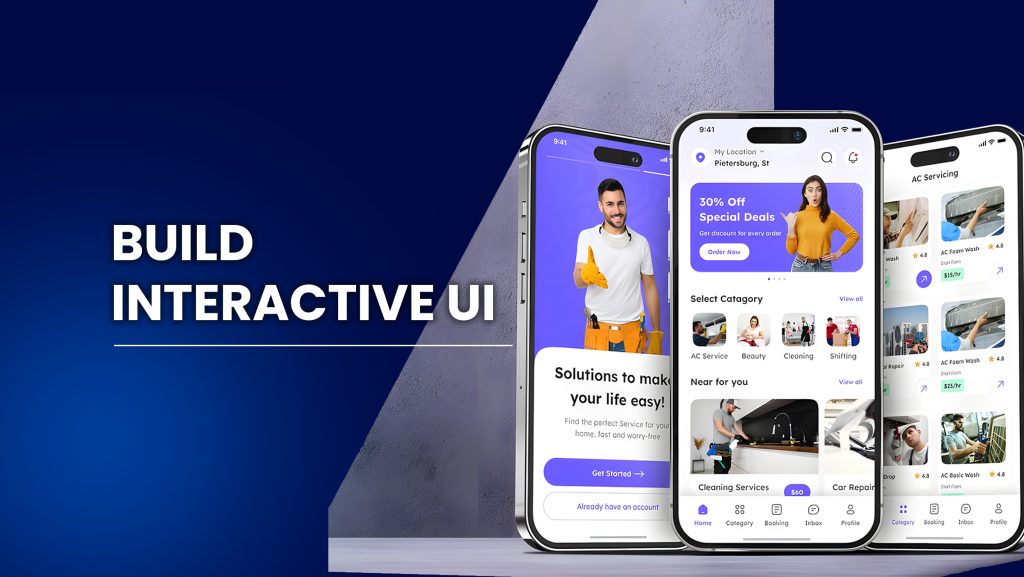
When it comes to user interface design, there are a lot of different ways to build interactive UI. In this blog post, we’re going to take a look at some of the most popular methods for building interactive UI. JQuery UI One popular method for building interactive UI is using a library such as jQuery UI. jQuery UI provides a wide variety of UI widgets that can be used to build interactive UI. AngularJS Another popular method is to use a framework such as AngularJS. AngularJS provides a lot of built-in directives that can be used to build interactive UI. React Another popular method for building interactive UI is to use a JavaScript library such as React. React is a JavaScript library that is used for building user interfaces. React has a declarative syntax that makes it easy to build interactive UI. Bootstrap Finally, another popular method for building interactive UI is to use a CSS framework such as Bootstrap. Bootstrap provides a lot of built-in CSS styles that can be used to build interactive UI. In conclusion There are a lot of different ways to build interactive UI. In this blog post, we’ve looked at some of the most popular methods for building interactive UI. Designing interactive user interfaces is a complex process that involves many different factors. The goal is to create a system that is both easy to use and effective. In order to do this, designers must consider the user’s needs, the context of use, and the technology available. There are many different approaches to interactive UI design, but one of the most important is to focus on the user’s needs. What are the user’s goals? What are their motivations? What do they need to do in order to complete their tasks? By understanding the user’s needs, designers can create interfaces that are both easy to use and effective. The context of use is also important when designing interactive UI. How will the user be using the interface? What are the environmental factors that need to be considered? For example, if the user will be using the interface in a noisy environment, the design must be able to accommodate that. Finally, designers must also consider the technology available when designing interactive UI. What devices will the user be using? What software do they have access to? What are the limitations of the technology? By taking all of these factors into account, designers can create interactive UI that are both easy to use and effective.
Important AWS Cloud Services
The first cloud computing service, Amazon EC2, was launched by Amazon, the leading cloud vendor, in 2008. AWS has more features and solutions available than any other provider, and its free tiers include access to the AWS Console, which enables users to manage all of their services from one location. AWS is intended for folks who are unfamiliar with software development tools and is built for ease of use across a range of skill sets. With AWS services, web applications may be deployed quickly without further coding or server infrastructure. Let’s look at the options that offer for this. You’ll find the essentials in our AWS services catalog to get you started. Compute Amazon EC2 (Elastic Compute Cloud)A safe, scalable cloud platform from Amazon is called EC2. It provides computing power. Its goal is to provide developers with simple access and usability for web-scale cloud computing while granting complete control over your computer resources. Amazon EBS (Elastic Block Store)High-performance block storage is utilized in Amazon EC2’s Amazon Elastic Block Store (EBS) for throughput and transaction workloads of any size and at any time. It manages a wide variety of workloads, including enterprise applications and relational and non-relational databases. Database Amazon RDS (Relational Database Services)With the help of Amazon Relational Database Service (Amazon RDS), setting up, managing, and scaling databases in the cloud is simple. Automate time-consuming operations like hardware provisioning, database configuration, patching, and backups in a way that is cost-effective and appropriate for your requirements. Storage Amazon S3 (Simple Storage Service)At its core, Amazon S3 enables object storage and offers industry-leading scalability, data accessibility, security, and performance. Large amounts of data may be stored and protected using S3 by businesses of all sizes for a variety of use cases, including websites, applications, backups, and more. Networking Amazon SNS (Simple Notification Service)A fully managed messaging service called Amazon SNS offers an inexpensive infrastructure for bulk message delivery, mainly to mobile users. Through system-to-system or app-to-person communication across decoupled microservice apps, users can chat directly with customers. Serverless Computing Serverless computing is a cloud computing execution model in which the cloud provider runs the server, and dynamically allocates machine resources on demand, so there is no upfront commitment of resources. A serverless computing platform allows developers to build applications and services without having to provision or manage any servers. The benefits of serverless computing include: In short, to improve the services, AWS services can learn, measure, and apply industry best practices. You’ll see that AWS services provide the best possible support for users, partners, and communities. Above all, AWS services support businesses in increasing productivity and shortening time to value by making the most use of resources and applications.